

Monthly Operation Report of WEB Crypto Fund No.1
March 2026
Report Date: April 3, 2026
Fund Name: WEB Crypto Fund No.1
Core Conclusion:
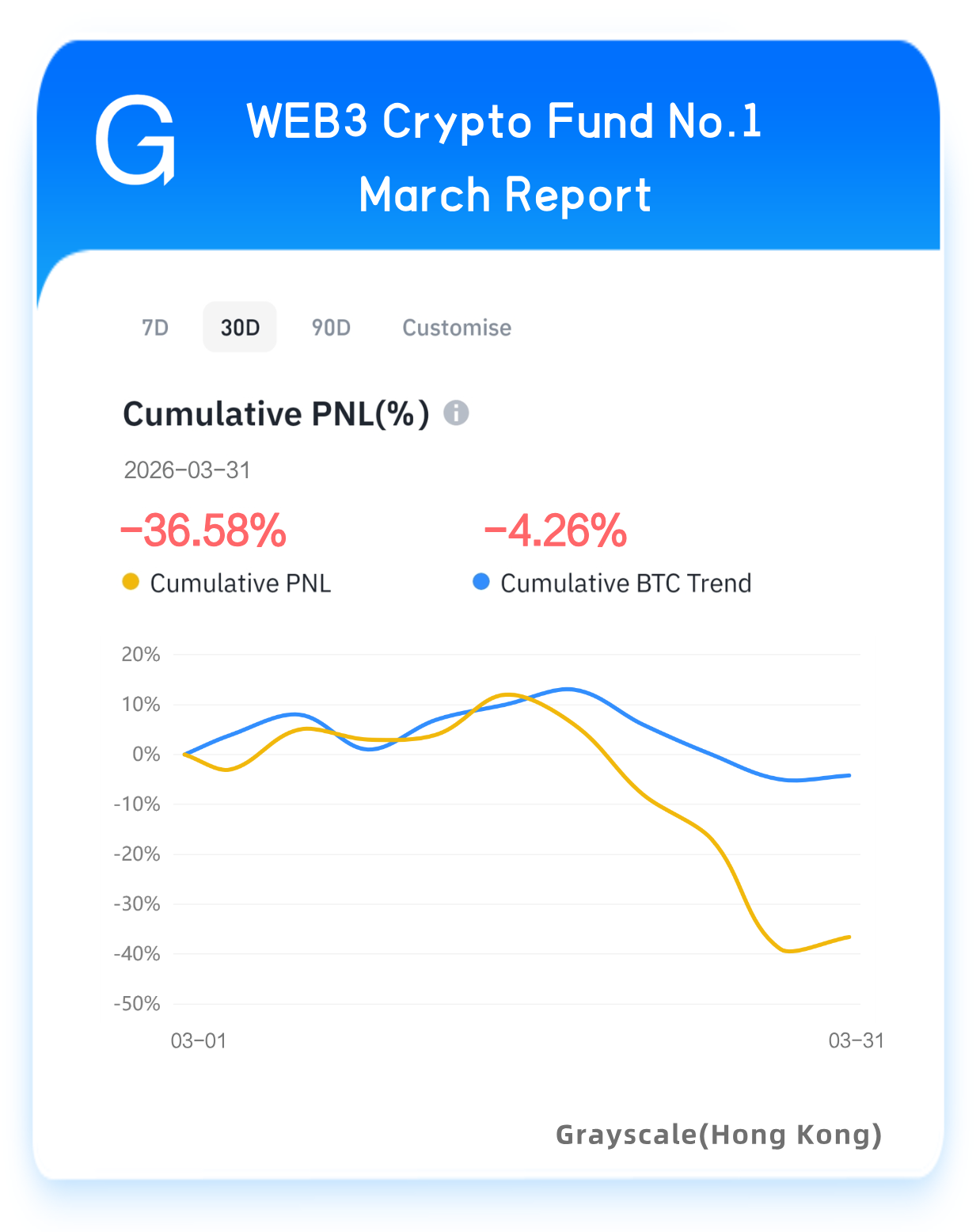
The fund suffered a significant net value drawdown this month affected by tightening macro liquidity, geopolitical risks and a stampede in the derivatives market, with a monthly return of -36.58%, underperforming the crypto market benchmark index. The main losses came from corrections in heavy holdings of major cryptocurrencies, forced liquidation of hedged leveraged positions, and valuation compression caused by regulatory uncertainty. Bitcoin traded range-bound between 66,000 and 69,000 at the end of the month. Priority should be given to preventing liquidity risks and cascading leveraged liquidations.
I. Performance
(I) Key Data
- Monthly return: 36.58% drawdown from the beginning of the month
- Benchmark comparison: The crypto market benchmark index fell approximately 5.8% in the same period
- Performance by asset class:
- Major crypto holdings: 10% of total loss
- Altcoin assets: 28% of total loss
- Hedged leveraged positions: 62% of total loss
(II) Return Attribution
Main sources of loss:
1. The hawkish March Federal Reserve meeting dashed rate-cut expectations. In a high-interest-rate environment, the valuation center of crypto assets moved downward. Bitcoin retreated from a monthly high of 76,000 to around 68,700, with a monthly decline of about 1.7%, directly dragging down performance through hedged leveraged positions.
2. Escalating geopolitical conflicts in mid-month triggered market panic. Coupled with the concentrated settlement of $14 billion worth of annual Bitcoin options, a cascade of long liquidations swept the derivatives market, with over 120,000 users liquidated totaling $446 million within 24 hours. Forced liquidation of the fund’s leveraged positions amplified losses.
3. Regulatory uncertainty accelerated capital outflows. The U.S. SEC revised digital asset regulations, leading to a sharp drop in market risk appetite, as capital shifted from crypto assets to gold and cash equivalents.
II. Market Environment and Industry Background
(I) Macro Liquidity: Sustained High-Rate Expectations, Tightening Liquidity
The Federal Reserve kept interest rates unchanged at 3.5%–3.75% in March. The dot plot indicated only one rate cut expected in 2026, a sharp reduction from previous forecasts. Meanwhile, the 2026 core PCE inflation forecast was raised to 2.7%, affirming the hawkish stance that “no rate cuts will be made until inflation meets the target”. Amid high interest rates, risk-free returns remained elevated, significantly increasing the opportunity cost of holding high-risk crypto assets and accelerating capital outflows.
(II) Geopolitics and Market Sentiment: Multiple Risks, Extremely Low Sentiment
Tensions in the Middle East (attacks on Iranian nuclear facilities, risks of closure of the Strait of Hormuz) pushed up oil prices and further fueled inflation expectations. Global risky assets weakened simultaneously, with the U.S. Magnificent Seven losing $850 billion in a single week. Safe-haven demand in the crypto market turned to gold. Meanwhile, crypto market trading volume shrank to its lowest level since January 2024, on-chain activity declined, and market sentiment remained in the fear zone.
(III) Industry Regulation: Stricter Supervision, Higher Compliance Costs
The U.S. SEC and CFTC signed a regulatory memorandum clarifying five classification standards for crypto assets. Revisions to the Digital Asset Market Structure Act tightened compliance channels and raised compliance costs.
III. Key Risk Events
1. After the outbreak of geopolitical conflicts in mid-March, Bitcoin plunged more than 3% in a single day and Ethereum fell below $2,000. High-leverage positions triggered forced liquidations, forming a “decline → liquidation → further decline” death spiral, widening weekly losses to 22%.
2. Option expirations in late March caused liquidity disruptions, accompanied by massive Bitcoin selling on exchanges. Bitcoin briefly dipped to a two-week low of $65,997, further deepening floating losses on holdings.
3. Rising expectations of regulatory implementation fueled concerns over the securities classification of some assets, causing altcoins and non-compliant assets to drop more than 15% monthly, dragging down overall performance.
IV. Risk Assessment and Response Measures
(I) Core Risks
1. Liquidity risk: Sustained low trading volume in the crypto market may lead to difficulties in asset liquidation under extreme market conditions.
2. Leverage risk: Remaining leveraged positions still face the risk of forced liquidation, which may exacerbate net value drawdowns.
3. Policy risk: The finalization of global crypto regulatory rules may trigger further capital outflows.
4. Market risk: Delayed Federal Reserve rate-cut expectations and escalating geopolitical conflicts may push crypto assets lower.
(II) Response Measures
1. Reduce leverage and control positions: Gradually close remaining leveraged derivative positions to reduce overall leverage to zero, raise cash holdings to 40% to mitigate forced liquidation risks.
2. Adjust and optimize the portfolio: Reduce non-compliant and highly volatile altcoins, increase allocations to core liquid assets such as Bitcoin to improve the portfolio’s downside resilience.
3. Closely monitor key variables: Keep a close eye on Federal Reserve meetings, geopolitical situations and global crypto regulatory developments to adjust holding strategies in a timely manner.
4. Strengthen risk control mechanisms: Improve stop-loss settings; initiate passive position reduction if the daily net value drop exceeds 5% to prevent systemic losses.
V. Future Outlook
In the short term, the crypto market will remain under the triple pressure of tightening liquidity, geopolitical disturbances and regulatory implementation. Bitcoin may trade range-bound between 65,000 and 70,000 with limited rebound potential.
In the medium term, two key variables will be closely watched:
1. Substantial improvement in Federal Reserve rate-cut expectations
2. Clear finalization of the global crypto regulatory framework
The fund will prioritize “risk control and liquidity preservation” in the future, with no aggressive position increases for the time being. It will gradually optimize the portfolio structure once market sentiment stabilizes and signals of easing liquidity emerge.